
Legal Heir Certificate in Chennai – Complete Guide for 2026
A Legal Heir Certificate is one of the most important documents required after the death of a family member. In Chennai Region, this certificate is commonly used for property transfer, pension claims, bank account settlement, insurance claims, gratuity benefits, and various legal procedures. The certificate officially identifies the surviving legal heirs of the deceased person and helps government departments, banks, and private institutions verify inheritance claims.
Many applicants are confused about the application process, required documents, fees, and the difference between a Legal Heir Certificate and a Succession Certificate. Delays often occur because of missing documents, incorrect information, or confusion regarding eligibility. Understanding the process beforehand can save considerable time and effort.
This guide explains everything you need to know about obtaining a Legal Heir Certificate in Chennai, including eligibility criteria, documents required, online and offline application methods, processing timelines, common reasons for rejection, NRI application procedures, and frequently asked questions. Whether you are applying for property transfer, pension benefits, or bank account settlement, this comprehensive guide will help you complete the process smoothly and efficiently.
What is a Legal Heir Certificate?
A Legal Heir Certificate is an official document issued by the Revenue Department that identifies the surviving legal heirs of a deceased person. In Tamil Nadu, it is commonly known as a Varisu Certificate. The certificate serves as proof of relationship between the deceased person and their family members and is often required to transfer assets, claim benefits, and complete various legal and administrative procedures.
When a person passes away, banks, government departments, insurance companies, pension authorities, and property registration offices may require proof of legal heirs before transferring ownership or releasing benefits. The Legal Heir Certificate fulfills this requirement.
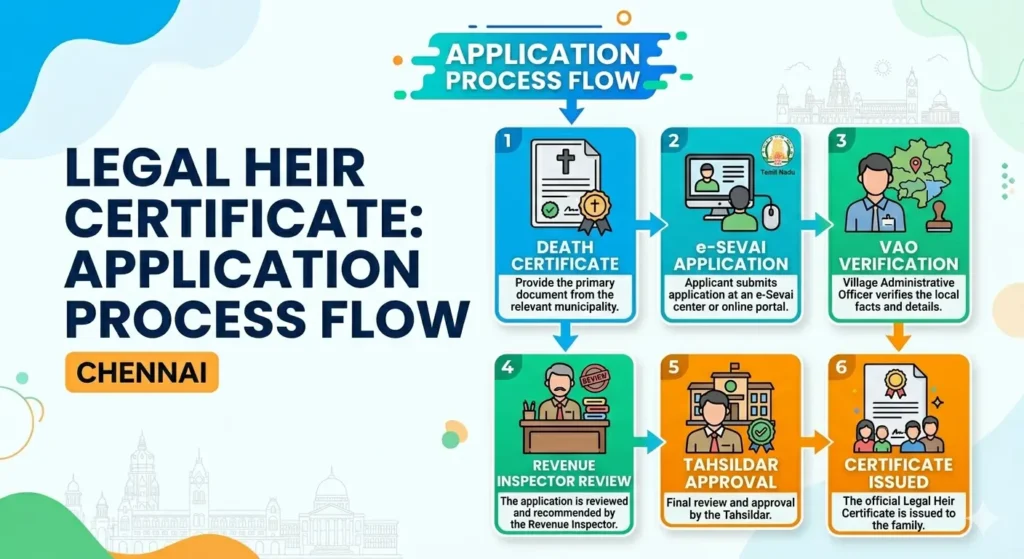
In Chennai, the certificate is generally issued by the Tahsildar after verification by the Village Administrative Officer (VAO) and Revenue Inspector (RI). The verification process confirms the details of the deceased person and the surviving family members.
Information Included in a Legal Heir Certificate
A Legal Heir Certificate generally contains:
Name of the deceased person
Date of death
Address of the deceased
Names of all legal heirs
Relationship of each heir to the deceased
Certificate issue date
Tahsildar approval details
Importance of a Legal Heir Certificate
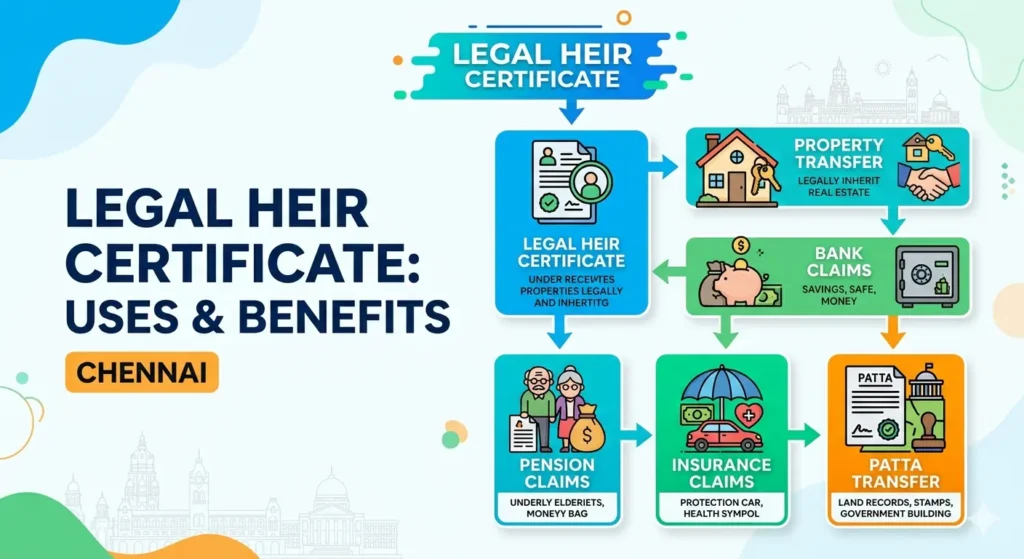
A Legal Heir Certificate helps legal heirs establish their relationship with the deceased and is commonly required for:
Property transfer
Patta transfer
Pension claims
Family pension applications
Insurance claims
Bank account settlement
Employment benefits
Gratuity and provident fund claims
Utility connection transfer
Without a Legal Heir Certificate, legal heirs may face difficulties proving their entitlement to assets and benefits belonging to the deceased family member.
Why is a Legal Heir Certificate Required in Chennai?
A Legal Heir Certificate is required whenever legal heirs need to establish their relationship with a deceased person for administrative, financial, or property-related purposes.
1. Property Transfer
One of the most common reasons for obtaining a Legal Heir Certificate is property transfer. When a property owner dies without transferring ownership during their lifetime, the legal heirs may need a Legal Heir Certificate to initiate mutation and transfer procedures.
2. Patta Transfer
Revenue authorities often require a Legal Heir Certificate when updating patta records after the death of a property owner.
3. Family Pension Claims
Government employees and pensioners frequently leave behind family members who are entitled to pension benefits. Pension departments generally request a Legal Heir Certificate before processing family pension applications.
4. Bank Account Settlement
Banks may require a Legal Heir Certificate before releasing funds from savings accounts, fixed deposits, or other financial instruments held by the deceased.
5. Insurance Claims
Insurance companies often request proof of legal heirs before settling life insurance policies when a nominee is not available or when additional verification is required.
6. Employee Benefits
Employers may request a Legal Heir Certificate before releasing gratuity, provident fund, leave encashment, and other employment-related benefits.
7. Electricity, Water and Utility Transfer
Utility departments may require legal heir documentation when transferring service connections to surviving family members.
8. Vehicle Ownership Transfer
Transport authorities may require proof of heirship before transferring ownership of vehicles registered in the name of a deceased person.
9. Court and Legal Proceedings
Certain legal matters involving inheritance and succession may require a Legal Heir Certificate as supporting evidence.
Obtaining the certificate at an early stage can significantly simplify the process of claiming assets and benefits.
Who Can Apply for a Legal Heir Certificate in Chennai?
The following family members are generally eligible to apply for a Legal Heir Certificate:
Eligible Legal Heirs
Wife
Husband
Son
Daughter
Mother
Father
In certain situations, other heirs may also be considered depending on the family structure and applicable inheritance laws.
Can a Married Daughter Apply?
Yes. A married daughter remains a legal heir and may be included in the Legal Heir Certificate along with other eligible heirs.
Can Multiple Heirs Be Included?
Yes. All surviving legal heirs are generally listed in a single Legal Heir Certificate. Omitting an eligible heir may result in objections or delays during verification.
Can an NRI Apply?
Yes. Non-Resident Indians (NRIs) can apply through an authorized representative using a valid Power of Attorney and supporting documents.
Who Should Submit the Application?
Usually, one family member submits the application on behalf of all legal heirs. However, the application should accurately include the details of every eligible heir.
Important Note
Providing incorrect information or intentionally excluding a legal heir can lead to rejection of the application and may create future legal complications. Therefore, applicants should ensure that all legal heirs are correctly identified and included in the application.
Documents Required for Legal Heir Certificate in Chennai
Before applying for a Legal Heir Certificate, applicants should keep all necessary documents ready. Submitting complete and accurate documents helps avoid delays and rejection during verification.
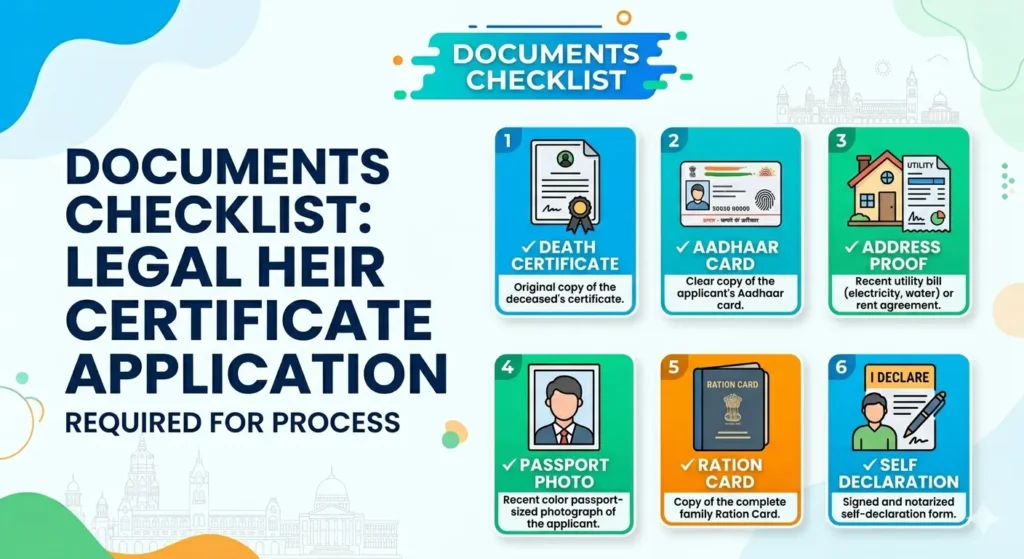
Mandatory Documents
| Document | Purpose | Mandatory |
|---|---|---|
| Death Certificate | Proof of death of the deceased person | Yes |
| Aadhaar Card of Applicant | Identity verification | Yes |
| Aadhaar Cards of Legal Heirs | Verification of family members | Yes |
| Address Proof | Residence verification | Yes |
| Passport Size Photograph | Applicant identification | Yes |
| Self-Declaration Affidavit | Declaration of legal heirs | Yes |
Additional Supporting Documents
| Document | When Required |
|---|---|
| Ration Card | Family relationship verification |
| Voter ID Card | Identity verification |
| Passport | Additional ID proof |
| Birth Certificate | Relationship proof |
| Marriage Certificate | Spouse verification |
| Property Documents | Property-related applications |
| Pension Documents | Pension claim cases |
Documents Required for NRI Applicants
| Document | Required |
|---|---|
| Passport Copy | Yes |
| Overseas Address Proof | Yes |
| OCI/PIO Card (if applicable) | Optional |
| Power of Attorney | Usually Required |
| Notarized Authorization Letter | Recommended |
Important Tips Before Submission
✔ Ensure names match across all documents.
✔ Aadhaar details should be updated and accurate.
✔ Include all legal heirs.
✔ Submit clear scanned copies.
✔ Keep originals available for verification.
Common Document Errors
Death certificate name mismatch
Missing heir details
Incorrect date of birth
Different addresses across documents
Missing supporting proof
These errors are among the most common reasons for application delays.
How to Apply for a Legal Heir Certificate in Chennai – Step-by-Step Process
Applicants can apply either through an e-Sevai Centre or through the online system where available.
Method 1: Apply Through e-Sevai Centre
This is the most commonly used method in Chennai.
Step 1: Collect Required Documents
Gather all documents including:
Death Certificate
Aadhaar Cards
Address Proof
Family Details
Step 2: Visit the Nearest e-Sevai Centre
Visit an authorized e-Sevai Centre with all documents.
Step 3: Submit Application
The operator will:
Enter applicant details
Enter deceased person’s details
Upload documents
Generate acknowledgement receipt
Step 4: Pay Applicable Charges
Pay the required government and service charges.
Step 5: Receive Application Number
Keep the acknowledgement number safely for status tracking.
Step 6: VAO Verification
The Village Administrative Officer may verify:
Residence details
Family details
Legal heir information
Step 7: Revenue Inspector Review
The Revenue Inspector reviews the submitted records and verification report.
Step 8: Tahsildar Approval
After successful verification, the Tahsildar approves the application.
Step 9: Certificate Issued
The Legal Heir Certificate becomes available for download or collection.
Application Workflow
Death Certificate Obtained
↓
Application Submitted
↓
e-Sevai Processing
↓
VAO Verification
↓
Revenue Inspector Verification
↓
Tahsildar Approval
↓
Certificate Issued
Typical Processing Timeline
| Stage | Estimated Time |
|---|---|
| Application Submission | 1 Day |
| VAO Verification | 3–7 Days |
| Revenue Inspector Review | 3–7 Days |
| Tahsildar Approval | 5–15 Days |
| Total Time | 15–30 Days |
Actual processing time may vary based on verification requirements.
Online Application Process for Legal Heir Certificate in Chennai
Applicants may use the Tamil Nadu e-Governance platform wherever online services are available.
Step 1: Create User Account
Register using:
Mobile Number
Email Address
Aadhaar Details
Step 2: Select Service
Choose:
“Legal Heir Certificate / Varisu Certificate”
Step 3: Fill Application Form
Provide:
| Information Required |
|---|
| Applicant Name |
| Deceased Person Name |
| Date of Death |
| Address |
| Family Member Details |
| Contact Information |
Step 4: Upload Documents
Upload:
Death Certificate
Aadhaar Cards
Address Proof
Supporting Documents
Step 5: Submit Application
Review all information carefully before submission.
Step 6: Track Application Status
Use the acknowledgement number to monitor progress.
Step 7: Download Certificate
Once approved, download the certificate or collect it from the designated office.
Advantages of Online Application
| Benefit | Description |
|---|---|
| Saves Time | No repeated office visits |
| Status Tracking | Real-time updates |
| Digital Records | Easy document storage |
| Faster Processing | Reduced paperwork |
| Convenience | Apply from anywhere |
Online Application Tips
✔ Use clear scanned copies.
✔ Double-check names and dates.
✔ Upload readable documents.
✔ Save acknowledgement receipt.
✔ Keep mobile number active for updates.
Fees for Legal Heir Certificate in Chennai
One of the most common questions applicants ask is about the cost of obtaining a Legal Heir Certificate in Chennai. The total cost may vary depending on whether the application is submitted directly through government channels or through a professional consultant.
Government Charges
Government charges for Legal Heir Certificate applications are generally nominal. However, charges may change from time to time based on government notifications.
e-Sevai Centre Charges
Applicants using e-Sevai Centres may be required to pay:
| Particulars | Approximate Cost |
|---|---|
| Application Processing Fee | As Applicable |
| e-Sevai Service Charge | As Applicable |
| Document Scanning Charges | Optional |
| Print Charges | Optional |
Consultant Assistance Charges
Many applicants prefer professional assistance because:
Documentation is verified before submission
Application errors are minimized
Follow-up support is provided
Time is saved
NRI applicants receive additional support
Factors Affecting Cost
| Factor | Impact |
|---|---|
| Number of Legal Heirs | Additional documentation |
| NRI Applicants | Additional paperwork |
| Missing Documents | Additional effort |
| Property-Related Cases | Additional verification |
| Court Matters | Separate legal expenses |
Is Professional Assistance Necessary?
No. Applicants can apply directly. However, professional assistance may help reduce delays and documentation errors, especially in complex family situations.
Legal Heir Certificate vs Succession Certificate – What’s the Difference?
Many people mistakenly believe that a Legal Heir Certificate and a Succession Certificate are the same. However, they serve different purposes.
Understanding this difference is important because submitting the wrong document may lead to rejection of your claim.
Comparison Table
| Feature | Legal Heir Certificate | Succession Certificate |
|---|---|---|
| Issuing Authority | Tahsildar | Civil Court |
| Purpose | Identify legal heirs | Transfer movable assets |
| Processing Time | 15–30 Days | 3–8 Months |
| Cost | Lower | Higher |
| Court Proceedings | Not Required | Required |
| Used For | Pension, Property, Employment Benefits | Shares, Debentures, Securities, Investments |
| Complexity | Simple | More Complex |
When Do You Need a Legal Heir Certificate?
A Legal Heir Certificate is commonly required for:
Family pension claims
Government employee benefits
Patta transfer
Utility connection transfer
Insurance claims
Property-related administrative procedures
When Do You Need a Succession Certificate?
A Succession Certificate may be required for:
Shares
Mutual Funds
Debentures
Bonds
Stock Market Investments
Certain Bank Deposits
Financial Securities
Example 1
A government employee passes away.
The family wants:
Family pension
Gratuity
Provident Fund
Generally, a Legal Heir Certificate may be required.
Example 2
A person dies leaving:
Demat account
Shares worth ₹10 lakh
Mutual funds
Financial institutions may request a Succession Certificate issued by a court.
Which Certificate Should You Apply For?
Many applicants first obtain a Legal Heir Certificate. Depending on the nature of assets involved, additional documentation or a Succession Certificate may later be required.
If you are unsure, professional guidance can help determine the correct certificate for your situation.
Common Reasons Why Legal Heir Certificate Applications Are Rejected
Although obtaining a Legal Heir Certificate is generally straightforward, applications may be delayed or rejected if the submitted information is incomplete or incorrect.
1. Name Mismatch
One of the most common reasons for rejection is inconsistency in names.
Examples:
| Document | Name |
|---|---|
| Aadhaar | R. Kumar |
| Death Certificate | Raj Kumar |
| Ration Card | Kumar Raj |
Such discrepancies often require clarification.
2. Missing Legal Heirs
All eligible legal heirs should be disclosed.
Failure to include:
Son
Daughter
Spouse
Mother
may result in objections or rejection.
3. Incorrect Address Details
The address mentioned in the application should match supporting documents.
4. Incomplete Documentation
Applications are often delayed because applicants fail to submit:
Death Certificate
Identity Proof
Address Proof
Relationship Documents
5. Family Disputes
Disputes among legal heirs may lead to:
Verification delays
Objections
Additional enquiries
6. Incorrect Date of Death
Details should exactly match the official Death Certificate.
7. Duplicate Applications
Submitting multiple applications for the same purpose can create confusion and delays.
8. Unclear Scanned Documents
Poor-quality document uploads may result in rejection during scrutiny.
Tips to Avoid Rejection
✔ Verify all names carefully.
✔ Include every legal heir.
✔ Upload clear documents.
✔ Review the application before submission.
✔ Keep supporting records ready.
✔ Seek professional guidance in complicated cases.
Application Checklist
Before submitting your application, ensure:
☑ Death Certificate Available
☑ Aadhaar Copies Available
☑ Address Proof Available
☑ All Heirs Listed
☑ Mobile Number Active
☑ Scanned Documents Clear
Completing this checklist significantly improves the chances of smooth approval.
NRI Legal Heir Certificate in Chennai
Many families have legal heirs living outside India. If one or more heirs are residing in countries such as the USA, UK, Canada, Australia, Singapore, UAE, or other nations, they can still be included in the Legal Heir Certificate application.
Can an NRI Apply for a Legal Heir Certificate?
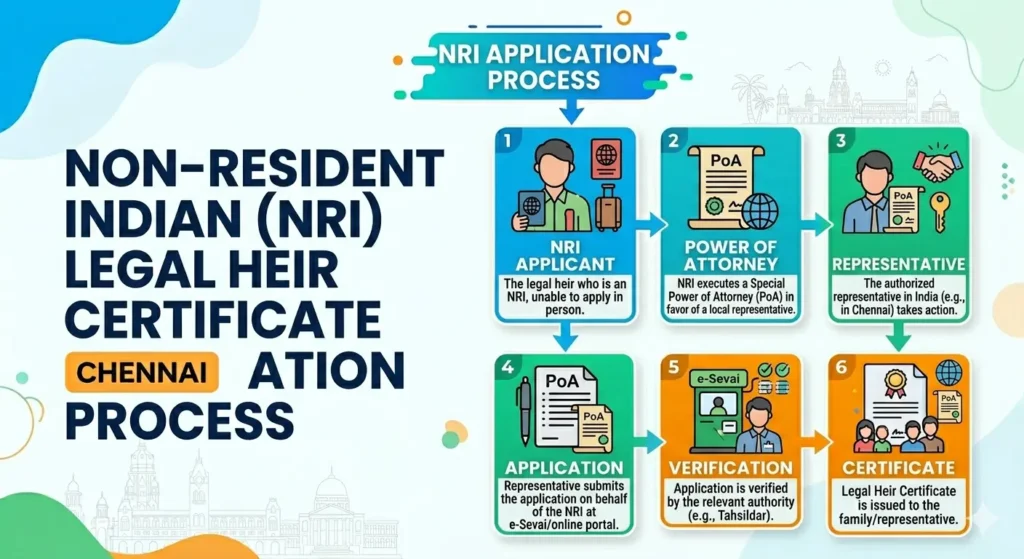
Yes. NRIs can apply through an authorized representative in Chennai by executing a valid Power of Attorney (POA).
Documents Required for NRI Applicants
| Document | Required |
|---|---|
| Passport Copy | Yes |
| Overseas Address Proof | Yes |
| Visa Copy | Recommended |
| OCI / PIO Card | If Available |
| Power of Attorney | Usually Required |
| Aadhaar Card | If Available |
| Passport Size Photo | Yes |
How Does the NRI Application Process Work?
Step 1
Prepare all identity and address documents.
Step 2
Execute a Power of Attorney authorizing a family member or representative in Chennai.
Step 3
Send notarized and attested documents to India.
Step 4
The representative submits the application.
Step 5
Revenue authorities verify heir details.
Step 6
Certificate is issued after approval.
Common Challenges for NRIs
Missing Indian address proof
Delays in document courier
Incorrect Power of Attorney format
Name mismatch between passport and Indian records
Tips for NRI Applicants
✔ Ensure passport details match other records.
✔ Include all legal heirs.
✔ Use a properly drafted Power of Attorney.
✔ Verify document attestation requirements before submission.
Many NRI families obtain Legal Heir Certificates to settle property matters, bank accounts, investments, pensions, and inheritance-related issues in India.
What Does a Legal Heir Certificate Look Like?
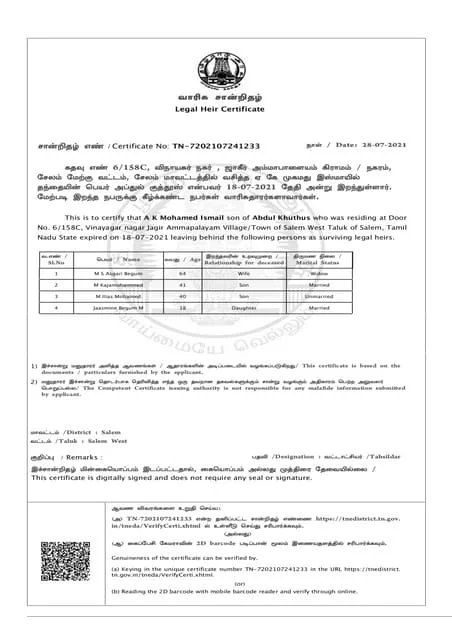
Legal Heir Certificate for Property Transfer in Chennai
One of the primary reasons people apply for a Legal Heir Certificate is to transfer property after the death of a family member.
When a property owner passes away, government departments and revenue authorities often require proof of legal heirs before mutation or ownership transfer can be processed.
Why is a Legal Heir Certificate Needed for Property Transfer?
The certificate helps establish:
Who the legal heirs are
Relationship with the deceased owner
Eligibility to inherit property
Property Types Covered
| Property Type | Legal Heir Certificate Required |
|---|---|
| Residential House | Usually Yes |
| Apartment | Usually Yes |
| Vacant Land | Usually Yes |
| Agricultural Land | Usually Yes |
| Commercial Property | Usually Yes |
Documents Commonly Required
| Document | Purpose |
|---|---|
| Death Certificate | Proof of death |
| Property Documents | Ownership proof |
| Patta Copy | Revenue records |
| Tax Receipts | Property verification |
| Aadhaar Cards | Identity verification |
| Legal Heir Certificate | Proof of legal heirs |
Property Transfer Process
Property Owner Passes Away
↓
Death Certificate Obtained
↓
Legal Heir Certificate Application
↓
Verification Process
↓
Certificate Issued
↓
Mutation / Patta Transfer Application
↓
Property Records Updated
Important Note
A Legal Heir Certificate identifies the heirs but does not automatically transfer ownership. Additional legal procedures may be required depending on the nature of the property and family circumstances.
Common Property Transfer Issues
Missing property documents
Disputes among heirs
Unregistered property
Missing tax records
Multiple claimants
Professional guidance can help avoid delays and ensure proper documentation.
Bank Account Settlement, Pension & Insurance Claims Using a Legal Heir Certificate
After the death of a family member, surviving legal heirs often need to claim funds, benefits, and financial assets. Many institutions require a Legal Heir Certificate as part of the verification process.
Bank Account Settlement
Banks may request heirship documents before releasing funds from:
Savings Accounts
Fixed Deposits
Recurring Deposits
Loan Security Deposits
Typical Documents Required by Banks
| Document | Purpose |
|---|---|
| Death Certificate | Confirmation of death |
| Legal Heir Certificate | Identification of heirs |
| Aadhaar Card | Identity verification |
| Bank Passbook | Account details |
| Application Form | Claim request |
Insurance Claims
Insurance companies may request legal heir documentation in situations where:
Nominee details are unavailable
Additional verification is required
Multiple heirs are involved
Pension Claims
Government and private pension authorities often require:
Death Certificate
Legal Heir Certificate
Pension Records
Family Details
before processing family pension applications.
Employment Benefits
The certificate may also help claim:
Provident Fund (PF)
Gratuity
Leave Encashment
Employee Welfare Benefits
Example Case
Mr. Ramesh, a retired government employee in Chennai, passed away leaving:
Family Pension Benefits
Fixed Deposit Accounts
Savings Account Balance
His wife and children obtained a Legal Heir Certificate and submitted it along with the death certificate and supporting documents to complete the claim process.
Benefits of Obtaining the Certificate Early
✔ Faster claim processing
✔ Reduced documentation issues
✔ Easier communication with institutions
✔ Simplified verification process
✔ Better record management
For many families, obtaining a Legal Heir Certificate is one of the first and most important steps in settling financial affairs after the loss of a loved one.
Real-Life Examples of Legal Heir Certificate Applications
Understanding real-world situations can help applicants determine whether they need a Legal Heir Certificate and how it may be used.
Case Study 1: Property Transfer After Father’s Death
Mr. Kumar, a resident of Anna Nagar, Chennai, passed away leaving behind a residential property.
His surviving family members included:
Wife
Son
Daughter
The family required a Legal Heir Certificate to establish heirship before initiating the property mutation process.
Steps Followed
Obtained Death Certificate
Collected Aadhaar cards of all heirs
Applied through e-Sevai Centre
Completed verification process
Received Legal Heir Certificate
Applied for property mutation
The certificate helped the family update revenue records and proceed with inheritance formalities.
Case Study 2: Family Pension Claim
A retired government employee passed away in Chennai.
His spouse needed to claim:
Family Pension
Gratuity Benefits
Leave Encashment
The pension department requested a Legal Heir Certificate as proof of legal relationship.
After obtaining the certificate, the family successfully completed the pension transfer process.
Case Study 3: NRI Legal Heir Application
A family residing in Canada needed to settle inherited property located in Chennai.
The NRI heirs:
Executed a Power of Attorney
Submitted passport copies
Authorized a representative in Chennai
The representative completed the application process and obtained the Legal Heir Certificate on behalf of the family.
Case Study 4: Bank Account Settlement
A Chennai resident passed away leaving fixed deposits and savings accounts.
The bank requested:
Death Certificate
Legal Heir Certificate
Identity Proof of Heirs
The heirs successfully claimed the account balances after completing the verification process.
Case Study 5: Insurance Claim Settlement
A policyholder passed away without updating nominee details.
The insurance company requested heirship documentation.
The family obtained a Legal Heir Certificate and submitted supporting records to complete the claim settlement process.
These examples demonstrate how a Legal Heir Certificate plays a crucial role in property, financial, pension, and insurance matters.
Why Choose Our Legal Heir Certificate Assistance Service in Chennai?
Applying for a Legal Heir Certificate can be time-consuming, especially when applicants are unfamiliar with documentation requirements or face complex family situations.
Our assistance service helps simplify the process from start to finish.
Our Services Include
✔ Document Verification
✔ Application Preparation
✔ e-Sevai Filing Assistance
✔ Follow-Up Support
✔ NRI Documentation Assistance
✔ Property Transfer Guidance
✔ Bank and Pension Claim Support
✔ Family Settlement Documentation Support
Benefits of Choosing Professional Assistance
| Benefit | Description |
|---|---|
| Reduced Errors | Thorough document review |
| Faster Processing | Proper application submission |
| Expert Guidance | Assistance throughout the process |
| NRI Support | Special handling for overseas applicants |
| End-to-End Service | From application to certificate issuance |
Who Can Benefit?
Families applying for the first time
Senior citizens
NRI applicants
Property owners
Pension claimants
Insurance claim beneficiaries
Areas We Serve
We assist applicants across Chennai, including:
Anna Nagar
Adyar
Velachery
Tambaram
Ambattur
Porur
Chromepet
T Nagar
Avadi
Perambur
Sholinganallur
Medavakkam
Pallavaram
Thiruvanmiyur
Mogappair
Need Assistance?
Our team can help review your documents, guide you through the process, and assist with application-related requirements.
FAQ's
A Legal Heir Certificate identifies the surviving legal heirs of a deceased person.
The certificate is generally issued by the Tahsildar after verification
Processing times vary but are often completed within a few weeks after successful verification.
Online services may be available through approved government platforms and e-Sevai services.
Identity verification documents are generally required.
Yes. A married daughter remains a legal heir.
Yes. All eligible legal heirs are generally listed.
Yes. NRIs may apply through an authorized representative
In many cases, yes.
Typically death certificate, identity proof, address proof, and family details
Yes, it is one of the primary documents required.
A Legal Heir Certificate may still be required for administrative purposes
Additional procedures may be necessary if heirs were omitted.
Yes, due to incomplete documentation or incorrect information.
A Legal Heir Certificate identifies heirs, while a Succession Certificate is generally used for certain financial assets and is issued by a court.
Generally, it may be accepted as proof of heirship, subject to institutional requirements.