
Death Certificate Chennai Corporation: Registration, Download and Correction Guide
A death certificate in Chennai is officially called a Chennai Corporation death certificate, issued by the Greater Chennai Corporation (GCC) for deaths within its limits. Register within 21 days (free) at your zonal office, then download online at chennaicorporation.gov.in using date of death and gender. Need help? We assist with the full GCC process, corrections, and delayed registration.
If someone close to you has died in Chennai, a death certificate in Chennai is issued by the Greater Chennai Corporation (GCC) once the death is registered – usually reported directly by the hospital for an institutional death, or by the family for a death at home. If the death is already registered, the certificate can often be searched for and downloaded online within a short time. This guide covers registration, the online and offline process, fees, corrections, delayed registration, and what a legal heir or nominee typically needs it for. We’ve tried to keep this practical and free of unnecessary detail, since you likely have enough to manage right now.
One distinction worth understanding early, because it trips people up at exactly the wrong moment: the hospital’s Medical Certificate of Cause of Death is not the same document as the official death certificate. You’ll almost always need both, at different stages.
Table of Contents
What Is a Death Certificate?
A death certificate is the legal record confirming that a person has died, along with the date, place, and cause of death, issued under the Registration of Births and Deaths Act, 1969. It’s the document banks, insurers, and government offices rely on to close accounts, process claims, and update records.
It’s easy to confuse three separate documents, so it’s worth being precise:
- The Medical Certificate of Cause of Death (MCCD) Form 4 for a hospital death, Form 4A for a death at home is filled in by a doctor and states the medical cause of death. It’s a medical document, not the legal certificate itself.
- The crematorium or burial-ground receipt confirms that last rites took place. It is not a substitute for the death certificate either, even though crematoria in Chennai typically ask for the MCCD before they proceed.
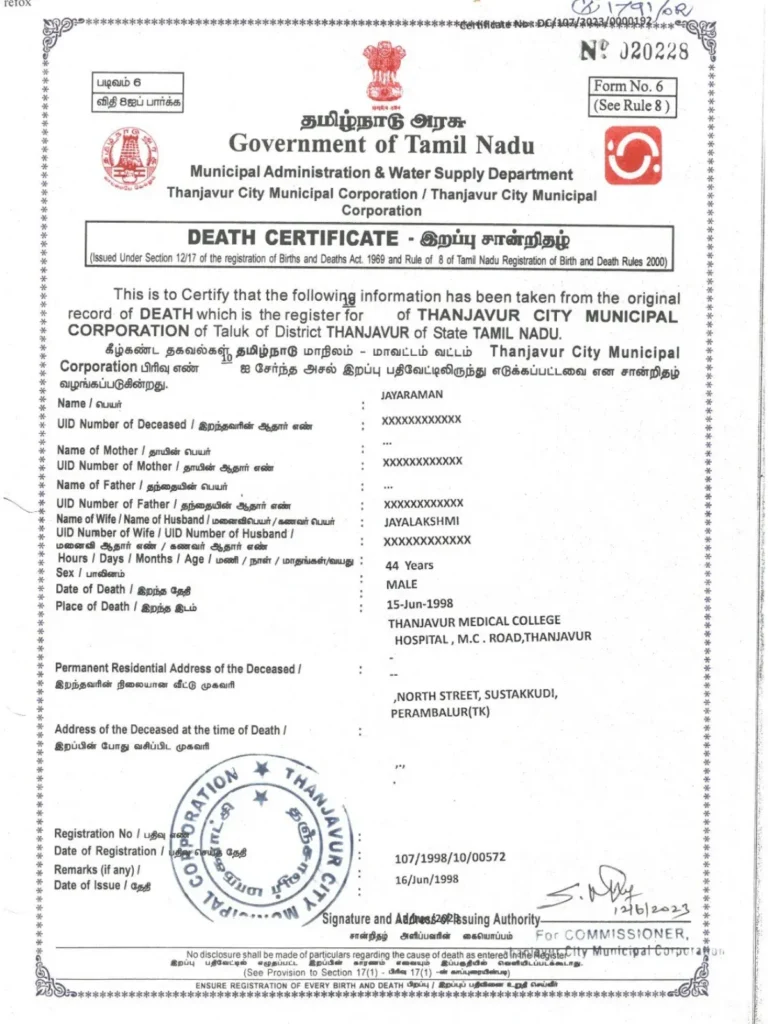
- The death certificate (Form 6) is the actual government record you’ll need for banks, insurance, property, and legal purposes issued only after the death is registered with GCC.
Registering the death and obtaining a copy of the certificate are also two different things: registration is a one-time event; requesting extra certified copies later is a separate, simpler step.
A death certificate is one of the key civil records issued by the government, similar to a birth certificate in Chennai, and serves as official proof for various legal and administrative purposes.
Who Issues Death Certificates in Chennai?
Also called a Chennai Corporation death certificate or GCC death certificate the Greater Chennai Corporation is the sole registering authority for deaths within its limits.
Within Chennai city limits, the Greater Chennai Corporation (GCC) registers deaths through its zonal offices (GCC now has 20 zones, following a 2025 restructuring from the earlier 15). Institutional deaths are typically reported by the hospital directly to the zone covering that hospital’s location; home deaths are reported by the family.
The same jurisdiction rule that applies to birth registration applies here: the correct registering authority depends on where the death actually occurred, not the deceased’s permanent address. If the death happened in Tambaram, Pallavaram, Pammal, or nearby areas now governed by the separate Tambaram City Municipal Corporation (since 2021), or in Avadi or Kanchipuram (also their own corporations), that is where the death is registered not GCC even if the family’s home address is elsewhere in “Chennai” in the everyday sense.
A second point worth getting right early: Tamil Nadu’s statewide civil registration portal, crstn.org, does not cover Chennai/GCC records. If your search for “Tamil Nadu death certificate download” lands you on crstn.org and nothing shows up, that’s very likely why go to GCC’s own portal instead.
For medico-legal deaths, the police become involved in reporting and documenting the death alongside the medical authorities more on this below.
Who Must Report a Death?
Responsibility for reporting a death depends on where and how it occurred:
- Hospital or medical institution: The institution’s medical officer reports it directly to the registering authority.
- Home death: The head of the household, or the nearest relative present, is generally responsible for reporting it, the same principle that applies to home births.
- Nursing home: Treated similarly to a hospital death, reported by the institution.
- Public place or during travel: Typically reported by whoever is present, often with police involvement depending on circumstances.
- Institutional settings (hostels, lodges, and similar establishments): The person in charge of the establishment is generally the informant.
- Unidentified person or disputed circumstances: Police involvement is standard practice here, since identity and cause of death both need to be established.
- Medico-legal case: The police (typically the Sub-Inspector of the area where the death occurred) act as the informant, since these cases proceed through inquest and post-mortem examination rather than a simple family report.
Exact legal responsibility can depend on the specific circumstances, so treat this as a general guide and confirm with the registering authority if your situation doesn’t fit cleanly into one category.
Why You May Need a Death Certificate
A death certificate is commonly required for:
- Life insurance claims
- Closing or transferring bank accounts and fixed deposits
- Pension claims and provident fund settlement
- Mutual funds and share transfers
- Property transfer and patta/revenue-record updates
- Vehicle ownership transfer
- Utility connection changes
- Legal heir certificate and succession certificate applications
- Probate or inheritance proceedings
- Aadhaar and PAN-related closure or updates
- Passport cancellation
- Government benefit closures
- Employer final settlement
- Loan closure
- Tax matters
- Updating family and marital records
Important: a death certificate alone is often not sufficient for every claim. Banks and insurers frequently ask for additional documents a legal heir certificate, succession certificate, nominee declaration, or probate depending on the amount involved and their own internal policy. Don’t assume one certificate closes every process.
For properties in Tamil Nadu, a death certificate is also needed during the patta transfer process to update land ownership records.
Death Registration Time Limits
The Registration of Births and Deaths Act, 1969 and the Tamil Nadu Rules, 2000 apply the same tiered structure to deaths as to births.
Registration situation | Likely process | Possible authority | Documents/approval | Important note |
Within 21 days | Direct registration, certificate available free of cost after verification | Zonal Registrar (GCC) | MCCD (Form 4/4A), crematorium/burial receipt, ID proof | Applies whether the death occurred in hospital or at home |
22–30 days | Direct registration with a late fee | Zonal Registrar (GCC) | Same as above + late fee | Confirm the current fee at the office |
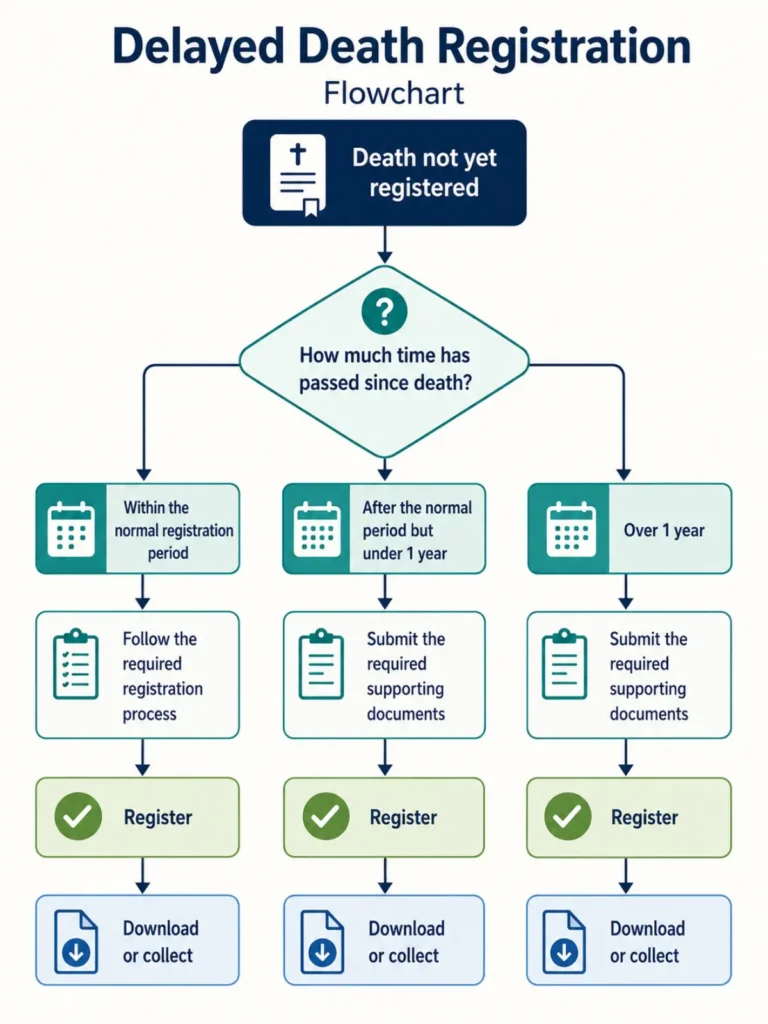
30 days to 1 year | Registration needs written permission of the prescribed authority | Officer above Registrar level | Affidavit + late fee | Some form of local verification/enquiry is typically involved before permission is granted |
More than 1 year | Registration only on a magistrate-level order | Executive Magistrate not below Revenue Divisional Officer rank (or applicable Judicial/Metropolitan Magistrate) | Form 2, Non-Availability Certificate (Form 10), affidavit, late fee | Officially documented at ₹500 in Tamil Nadu civil registration records, though this should be reconfirmed, since older sources cite very different figures |
Fees may vary depending on the service, delay period, and registration authority. Confirm the current amount through the official portal or registration office before making payment.
Documents Required
Exact requirements vary by the type of death and how much time has passed. As a starting checklist, confirmed with your zonal office before you go:
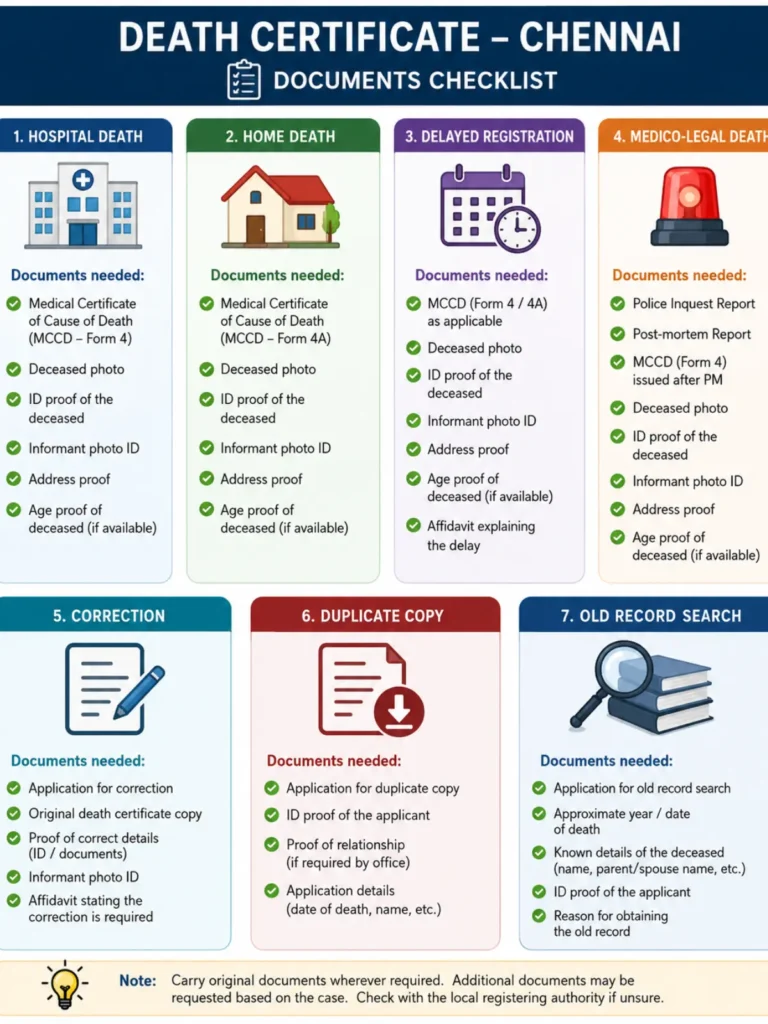
- Hospital death: MCCD (Form 4) from the hospital, hospital death summary, identity proof of the deceased and informant.
- Home/natural death: MCCD (Form 4A) signed by an authorised doctor with registration number, identity and address proof, crematorium/burial receipt.
- Natural death (general): Same as home death doctor’s certification is the key document.
- Medico-legal death: Police report/inquest documentation, post-mortem report, police No Objection Certificate for cremation/burial where applicable.
- Post-mortem case: Post-mortem report summary, police documentation, hospital or mortuary records.
- Delayed death registration: Affidavit, supporting evidence (medical, crematorium, or other records), late fee.
- Old death-record search: Approximate date and place of death, deceased’s name and parents’/spouse’s name, any available reference like a hospital or ration card record.
- Death-certificate correction: Existing certificate copy, proof supporting the correct detail, affidavit for substantial changes.
- Duplicate/additional copy: Registration number or date of death, applicant’s ID proof.
- Applicant living outside Chennai: Same documents as above; most steps can be completed online, with in-person visits handled through a trusted representative if needed.
- NRI applicant: Passport copy, proof of relationship to the deceased, authorisation letter if a representative is applying on your behalf.
- Legal heir or authorised representative: Proof of relationship, identity proof, and where a bank, insurer, or authority asks for it a legal heir certificate or succession certificate.
- Death without available hospital records: Non-Availability Certificate, alternative supporting records (ration card, electoral roll, employer or pension documents).
- Unidentified or disputed-record situations: Handled through police and the registering authority together; specific document requirements depend on the case.
What to Do Immediately After a Death
A short, practical checklist for the first hours and days:
- [ ] Obtain medical confirmation of death
- [ ] Request the Medical Certificate of Cause of Death (Form 4 for hospital, Form 4A for home) where applicable
- [ ] Confirm whether the hospital will report the death directly, or whether the family needs to
- [ ] Keep hospital records and identity documents together and safe
- [ ] Double-check the spelling of the deceased’s name
- [ ] Confirm age, gender, address, spouse’s name, and the exact date and place of death
- [ ] Keep the crematorium or burial-ground receipt
- [ ] Identify the correct registering authority based on where the death occurred
- [ ] Keep copies of everything submitted
- [ ] Ask for an acknowledgment or registration reference
Worth knowing: the certificate isn’t automatically ready the moment the hospital reports the death there’s usually a short processing window before it’s searchable online.
Hospital Death Registration Process
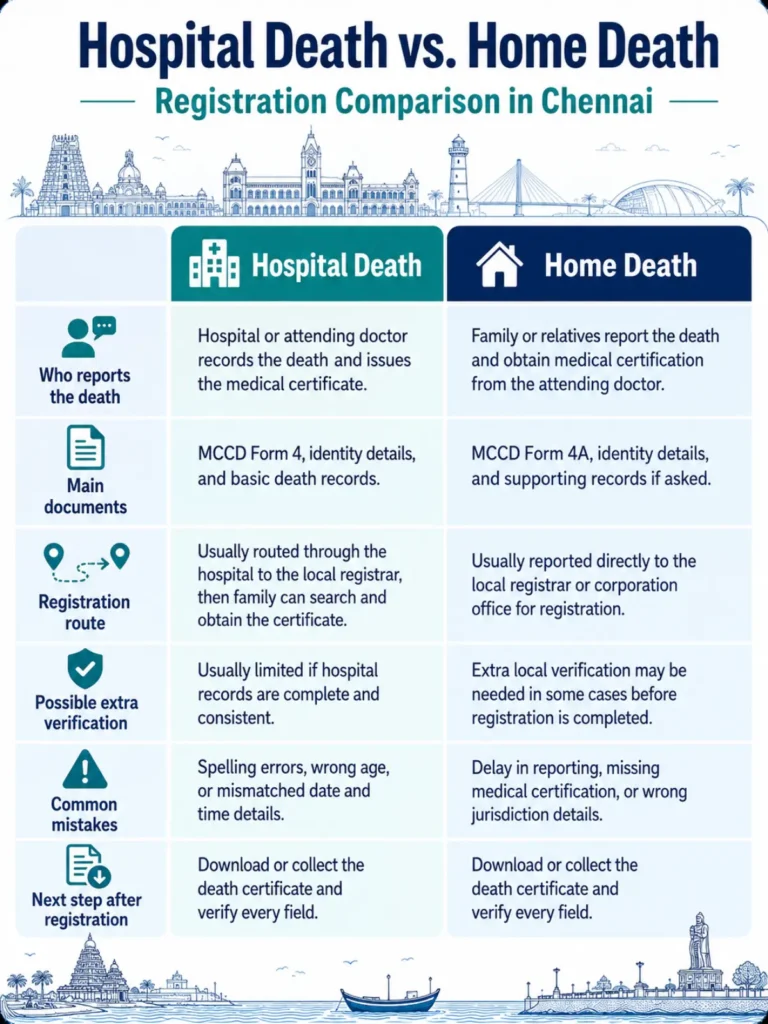
- The hospital typically reports the death directly to the registering authority and issues the MCCD (Form 4).
- The family’s role is mainly to confirm that the personal details name, age, address, date and time of death are correctly recorded before leaving the hospital.
- Ask the hospital whether they will submit the report electronically, and roughly how long registration is expected to take.
- After a few days, check GCC’s online portal to see if the certificate is available.
- If any hospital-entered detail is wrong, raise it with the hospital first it’s easier to fix at source than after municipal registration.
- If the hospital has since closed or records are hard to trace, the Non-Availability Certificate route (covered under Delayed Registration below) applies.
Home Death Registration Process
- Contact the family doctor or a local registered medical practitioner to confirm the death and, where the death is natural, obtain the MCCD on Form 4A.
- If no attending doctor is available, the practical next step is usually the nearest hospital, though be aware this can be treated as a “brought dead” case, which typically requires further medical evaluation before an MCCD can be issued and may become a medico-legal matter if the cause isn’t clearly natural.
- Keep proof of the deceased’s residence or the place of death.
- The head of household (or nearest relative present) reports the death to the zonal registrar, generally within 21 days.
- The crematorium or burial ground will usually ask for the MCCD before proceeding keep this document accessible, not packed away.
- After cremation or burial, keep the crematorium’s acknowledgment; you’ll need it to complete registration at the zonal office if it wasn’t already filed.
Medico-Legal and Post-Mortem Cases
Some deaths unnatural, sudden, unexplained, or where no doctor can certify natural causes are treated as medico-legal cases. This isn’t a judgment about the family; it’s a standard procedural safeguard.
- In these cases, the police (generally the Sub-Inspector for the area) act as the informant to the registrar, rather than the family.
- A post-mortem examination and police inquest are typically required before the cause of death is finalised.
- Cremation or burial in such cases generally requires a police No Objection Certificate along with the post-mortem report summary.
- These cases understandably take longer than a straightforward natural death, since they depend on medical and police processes outside GCC’s control.
- What the family can safely do: keep every document the hospital, police, or mortuary provides, ask for receipts and reference numbers at each stage, and follow up through official channels rather than intermediaries.
- This is not the place to look for a shortcut a genuine medico-legal requirement can’t be bypassed by “knowing someone” or paying an unofficial party, and anyone suggesting otherwise should be treated with real caution.
We won’t go further into police procedure here, since interfering with or second-guessing an active investigation isn’t something a general guide should attempt your point of contact for case-specific questions is the investigating officer or the hospital’s medico-legal department.
How to Register a Death in Chennai?
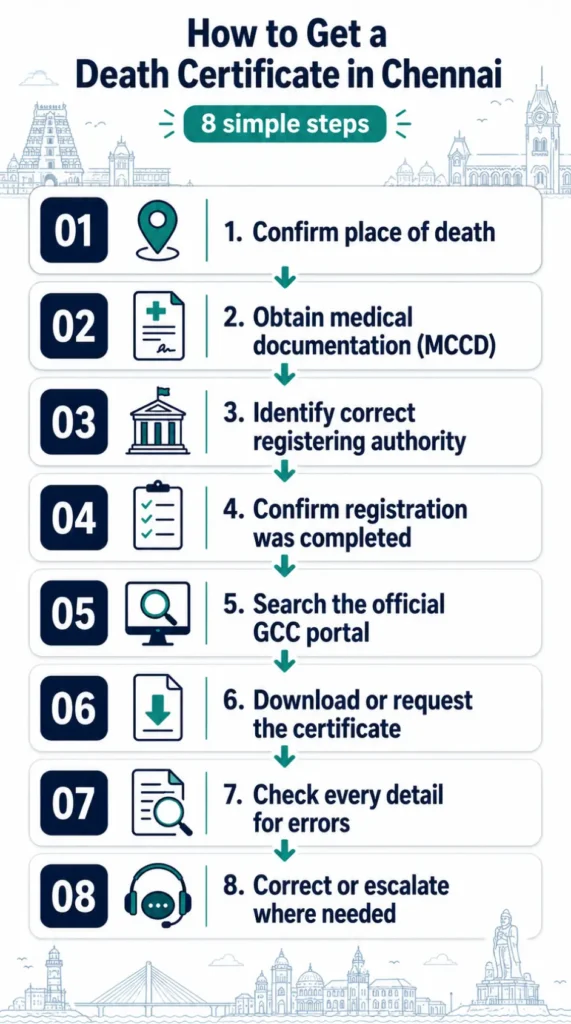
- Confirm the exact place of death.
- Identify the correct registering authority for that location (GCC, or another corporation/local body).
- Gather the MCCD and any supporting medical or police records.
- Confirm who is formally reporting the death (hospital, family, or police, depending on the case).
- Check every personal detail before submission names, dates, addresses.
- Submit the report or application through the appropriate channel.
- Pay any applicable official fee.
- Get a written acknowledgment.
- Track the registration status.
- Search for and download the certificate once available.
- Check the certificate carefully for errors.
- Apply for a correction promptly if anything is wrong.
How to Apply for a Death Certificate Online in Chennai?
To download your Chennai Corporation death certificate, the official portal is chennaicorporation.gov.in (Death Certificate Download) the same GCC system used for birth registrations.
If the death is already registered and you need the certificate itself:
- Go to GCC’s online services on chennaicorporation.gov.in and select Death Certificate Download (also available through gccservices.in).
- Search using the mandatory fields typically gender and date of death adding the registration number, the deceased’s name, or father’s/husband’s/mother’s name to narrow the result.
- Select the correct record.
- Complete payment where required before the download is generated (reported at roughly ₹30 through the e-Sevai/e-District printing service confirm the current amount).
- Download the certificate. GCC’s certificates are computer-generated, don’t need a physical seal or signature, and the portal offers an authenticity-verification option.
If you’re going through a Common Service Centre or e-Sevai operator, the process uses the same underlying service (COC-102 on the e-District portal), with the operator handling the search and payment steps on your behalf.
How to Search and Download a Chennai Death Certificate?
- You’ll typically need the date of death and gender, plus at least one of registration number, the deceased’s name, or a parent’s/spouse’s name.
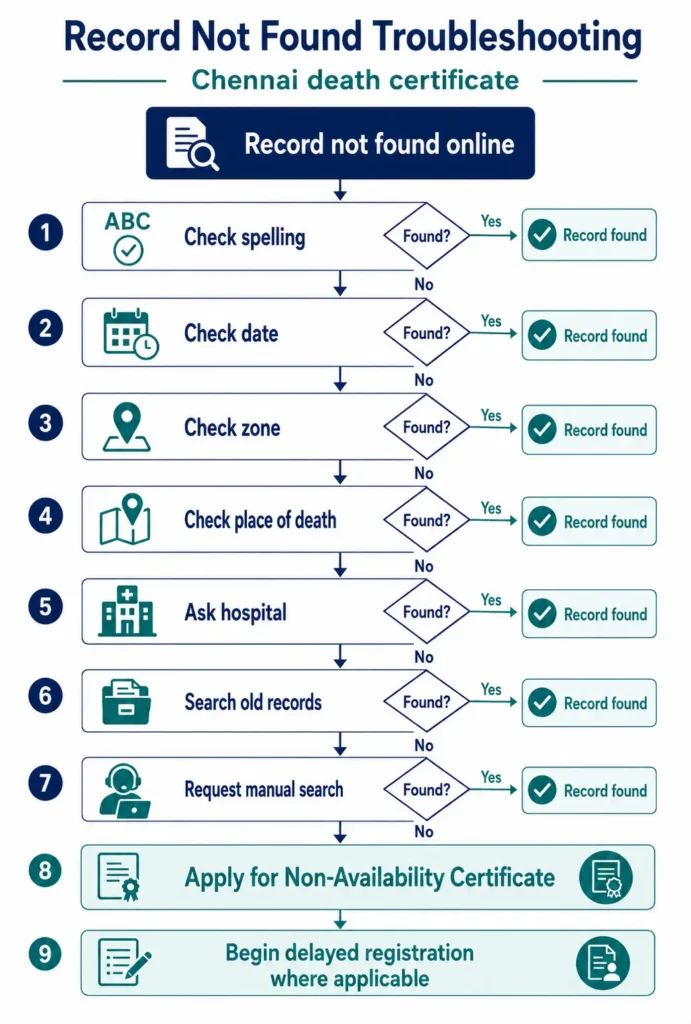
- If nothing turns up, try alternate spellings Tamil names transliterate into English more than one way and double-check the exact date against hospital or family records, which don’t always agree perfectly.
- Once downloaded, check every field immediately: name, date, age, gender, place of death, parents’/spouse’s name.
- Use the portal’s own verification option to confirm authenticity, rather than assuming any PDF someone hands you is genuine.
- Older death records may not be digitised yet, so a “record not found” result for an old death doesn’t necessarily mean it was never registered.
Offline Application Process
- Identify the correct zonal office for the place of death, not the deceased’s home address.
- Carry original documents plus photocopies.
- Ask for a written acknowledgment or receipt for anything submitted.
- Note the reference or application number for tracking.
- Never hand over original documents to anyone other than a verified corporation official, and never make payments to an individual rather than an official counter or portal.
Specific zonal office addresses aren’t listed here, since GCC’s zonal structure was updated as recently as 2026 confirm the current zone and office location on chennaicorporation.gov.in.
Death Certificate Fees in Chennai
Service | Typical fee position |
Registration within 21 days | Free |
Late registration, 22–30 days | Small prescribed late fee |
Late registration, 30 days–1 year | Late fee + affidavit cost (confirm current amount) |
Late registration, over 1 year | Late fee (documented at ₹500 in Tamil Nadu civil registration records) + magistrate/RDO order costs |
Certificate download/print (already registered) | Free-to-nominal; e-Sevai/CSC printing has been reported around ₹30 per copy |
Correction | Varies by whether it’s clerical or a substantial change requiring an affidavit |
Search/Non-Availability Certificate | Nominal search fee where records must be located manually |
Fees may vary depending on the service, delay period, and registration authority. Confirm the current amount through the official portal or registration office before making payment.
Processing Time
- Hospital death registration: Often the fastest path, since the institution reports it directly.
- Home death registration: Broadly similar timing once the MCCD and required documents are submitted, assuming no complications.
- Online certificate availability: Frequently within a short window after registration, though this depends on how quickly the record is uploaded.
- Delayed registration (30 days–1 year): Longer, due to the additional approval step.
- Delayed registration (over 1 year): The slowest path, tied to the magistrate/RDO order timeline.
- Corrections: Ranges from a few days for clerical fixes to considerably longer for substantial changes needing verification.
- Medico-legal cases: Timing depends on police and post-mortem processes outside GCC’s control, and can take noticeably longer than a natural-death case.
Treat these as general patterns rather than guarantees document completeness, holidays, and record age all affect the real timeline.
How to Correct Errors
Corrections scale with how significant the change is:
- Minor clerical correction (an obvious spelling slip): Usually the lightest process existing certificate copy plus supporting ID proof.
- Correction supported by original hospital records: Where the hospital’s own paperwork already shows the correct detail, this is often more straightforward than a change with no supporting record.
- Substantial change (date of death, age, gender, or a name that isn’t a simple spelling fix): Typically needs an affidavit and independent supporting evidence, and may require a higher level of approval or an enquiry.
- Change involving legal identity (a full name correction, for instance): May also need a Gazette Notification through the Tamil Nadu Directorate of Printing and Stationery, in addition to the corporation-level update.
Corrections commonly requested cover the deceased’s name, date of death, time of death, age, gender, address, place of death, father’s/mother’s/spouse’s name, informant details, and hospital details. Not every major correction can be resolved through a simple online form confirm the specific document list for your situation with the zonal office.
Delayed Death Registration
Decision tree:
Was the death already registered?
├─ Yes → Search the record online → Download, or apply for correction as needed
└─ No → Confirm whether the hospital already reported it, then check time elapsed
├─ Under 30 days → Register directly with a late fee
├─ 30 days to 1 year → Obtain Registrar’s written permission + affidavit + late fee → Register
└─ Over 1 year → Obtain Non-Availability Certificate (Form 10) → Gather medical, crematorium,
and identity records → Apply for magistrate/RDO order → Register once the
order is granted → Download or collect the certificate
Supporting evidence commonly requested includes medical records (if any exist), crematorium or burial-ground records, identity documents of the deceased and informant, and sometimes family or witness declarations. The Non-Availability Certificate confirms no existing registration was found it’s a prerequisite for the magistrate/RDO order, not a certificate substitute.
Death Certificate for an Old Death
For a death that occurred many years ago:
- Search GCC’s online database first, using the approximate date, place, and names available.
- If nothing appears, a manual register search at the zonal office may be needed, especially for pre-digitisation records.
- Gather whatever supporting records exist hospital records, crematorium/burial receipts, electoral roll or ration card entries, pension or employer documents.
- If no registration exists at all, request a Non-Availability Certificate and follow the delayed-registration process above (almost always the “over 1 year” category for an old death).
- Be prepared for spelling differences between very old records and current documents this is common, not a sign of a bigger problem.
Lost Death Certificate or Duplicate Copy
Losing the certificate doesn’t mean re-registering the death the record already exists, so you need another copy of it:
- If you have the registration details: Redownload from GCC’s portal directly.
- If you don’t remember the exact details: Visit the zonal office with whatever information you have (approximate date, name, relationship) and request a search.
- Certified copy: For situations specifically requiring an office-issued certified copy rather than a self-printed download, request this at the zonal office.
- A police complaint isn’t a standard requirement just to get a duplicate copy only follow that step if a specific authority explicitly asks for it.
- Store the new copy securely, ideally alongside other estate-related documents.
Death Certificate for Legal Heirs and Nominees
This is an area where families are often surprised, so it’s worth being clear: a nominee and a legal heir are not automatically the same person.
- A nominee is whoever the deceased named to receive a specific asset a bank account, insurance policy, or investment and in many cases acts more like a custodian for collecting the proceeds than an automatic final owner.
- A legal heir is determined by the succession law that applies to the deceased (based on religion and whether there was a valid will), and may include people who were never named as a nominee anywhere.
Because of this gap, banks and insurers frequently ask for more than just the death certificate a legal heir certificate, a succession certificate, or (for larger or disputed estates) a probate order before releasing funds, especially where there’s no nominee or where multiple heirs might have a claim. If you’re managing an estate with any complexity (multiple potential heirs, no will, high-value assets, or family disagreement), this is a genuine legal question worth taking to a lawyer rather than relying on general guidance this page can’t responsibly give you a personalised answer to “who gets what.”
For an NRI managing a Chennai death from abroad, the same principle applies, generally handled through a properly executed power of attorney or authorisation letter again, something to set up correctly with legal advice rather than guesswork.
Application Status Tracking
- Keep the acknowledgment or reference number from your submission safe.
- Check status through the same portal you applied on.
- Typical status stages include pending verification, approved, certificate generated, correction requested, or additional documents required.
- If status doesn’t move for an unreasonable length of time, follow up directly with the zonal office.
- For unresolved delays, escalate through GCC’s grievance channel (helpline 1913, or the online grievance portal).
Record Not Found: Troubleshooting Checklist
Before assuming a death was never registered, check for:
- Wrong date of death entered, or day/month reversed
- Spelling differences, especially with Tamil names
- Incorrect gender field
- Wrong zone or division
- Death actually occurring outside GCC limits despite a Chennai postal address
- The hospital using a different recorded address than expected
- The record simply not yet approved or uploaded
- Very old records that haven’t been digitised
- An incorrectly remembered registration number
- Confusing the deceased’s permanent address with the actual place of death
- The hospital not having submitted its report yet
- A genuinely unregistered death (in which case, delayed registration applies)
- Temporary portal downtime
Before Applying Checklist
- [ ] Confirm the exact place of death
- [ ] Identify the correct local authority for that place
- [ ] Search for an existing record before assuming you need to register
- [ ] Confirm the exact date and time of death
- [ ] Check the deceased’s full name for spelling accuracy
- [ ] Confirm age and gender
- [ ] Check spouse’s and parents’ names for consistency across documents
- [ ] Gather medical documents (MCCD, hospital records)
- [ ] Keep cremation/burial records safe and accessible
- [ ] Keep identity and address proof ready
- [ ] Scan documents clearly
- [ ] Keep a working mobile number and email available
- [ ] Note the acknowledgment number the moment you receive it
- [ ] Avoid unofficial payment requests
- [ ] Never submit altered or false information
After Applying Checklist
- [ ] Save the acknowledgment number
- [ ] Track status periodically
- [ ] Check every field on the certificate immediately
- [ ] Verify spelling of names
- [ ] Verify date and place of death
- [ ] Report any error promptly
- [ ] Download and store secure copies (digital and printed)
- [ ] Use the portal’s verification feature if needed
- [ ] Never alter the downloaded PDF
- [ ] Use only official correction channels
- [ ] Keep the certificate with other estate documents
Urgent Requirement Guidance
If you need the certificate quickly for a bank, insurer, or legal deadline:
- Confirm whether registration already exists before assuming you need to start from scratch
- Use the correct authority the first time
- Prepare complete, clearly matched documents
- Use clear scanned copies, not blurry photos
- Track the application proactively
- Respond quickly if additional documents are requested
- Use official grievance channels if something stalls
- Visit the correct office in person if the online system is unavailable
There is no legitimate same-day guarantee, no guaranteed approval, and no official backdating service. No private person can legally bypass death-registration, delayed-registration, medical, police, or correction requirements. Pay fees only through official channels, and always get a receipt.
Common Mistakes
- Applying to the wrong local body based on the deceased’s home address instead of place of death
- Assuming crstn.org covers Chennai records
- Confusing the Medical Certificate of Cause of Death with the official municipal death certificate
- Assuming the hospital’s paperwork alone is the final certificate
- Entering the wrong date or zone
- Using inconsistent initials across documents
- Uploading unclear or partial documents
- Losing the acknowledgment number
- Attempting to register the same death twice
- Paying an unofficial agent instead of the official portal or counter
- Relying on an outdated portal URL or menu name from an old post
- Delaying a correction after spotting an error
- Not preserving the cremation or burial receipt
- Assuming all old records are automatically searchable online
- Submitting unsupported or inconsistent change requests
- Altering a downloaded certificate
- Providing false declarations to speed up a case
- Not checking whether a medico-legal case’s paperwork is fully complete before assuming registration can proceed
FAQ QUESTION
If the death is already registered with GCC, you can search and download it through GCC's online services using date of death, gender, and optionally the registration number or the deceased's name.
Visit GCC's Death Certificate Download service, search with the required fields, select the correct record, complete payment if applicable, and download.
The Greater Chennai Corporation, through its zonal offices, for deaths within GCC's actual limits.
Registered deaths are often available online within a short window; delayed or medico-legal cases take longer, since they depend on additional approvals outside GCC's control.
It depends on the type of death hospital, home, medico-legal, or delayed registration each need a different document set; see the Documents Required section above.
The hospital for an institutional death, the family (usually the head of household) for a home death, or the police for a medico-legal case.
Generally yes, for institutional deaths but it's worth confirming with the hospital rather than assuming, and checking the recorded details before you leave.
No. The hospital summary and the Medical Certificate of Cause of Death support registration; the actual death certificate is issued by GCC only after registration is complete.
It's the medical document (Form 4 for hospital deaths, Form 4A for home deaths) where a doctor records the cause of death a required input to registration, not the certificate itself.
A doctor confirms the death and issues Form 4A where the death is natural; the head of household then reports the death to the zonal registrar, generally within 21 days.
The process depends on how much time has passed see the Death Registration Time Limits table and the Delayed Death Registration section above.
Check for date, spelling, or jurisdiction issues first, and confirm with the hospital or zonal office whether registration was actually completed before assuming the worst.
Date of death and gender are typically the mandatory fields; adding a registration number or the deceased's name helps narrow multiple matches.
Check any acknowledgment given at the time of registration, or search using date of death, gender, and names instead.
Minor clerical corrections are usually the simplest category submit the existing certificate copy with supporting ID proof.
Yes, though this is treated as a more substantial correction requiring supporting evidence, since it affects a legally significant fact.
This typically needs supporting proof (such as the marriage certificate or another official record) alongside the correction request.
Redownload it from GCC's portal if you have the registration details, or visit the zonal office for a search and certified copy if you don't.
GCC's computer-generated downloads are designed for use without a physical seal or signature and include an online verification option.
GCC's computer-generated downloads are designed for use without a physical seal or signature and include an online verification option.
es legal heirs, nominees, and authorised representatives can generally apply for and use the certificate, though banks and insurers may separately ask for proof of your relationship or legal standing.
Yes, most of the process can be completed online; only specific offline steps need a visit or a trusted representative.
Yes, the online process is generally accessible from abroad; where a representative needs to act in person, a properly executed authorisation is the safer route.
An official statement confirming no existing death registration was found required before delayed registration beyond one year can proceed.
Yes, for both the 30-days-to-1-year and over-1-year categories, alongside the other documents specific to each.
Police become the reporting authority, and a post-mortem examination is typically required before cause of death is finalised this takes longer than a straightforward natural death and isn't something a family can accelerate through unofficial means.
Yes, particularly for older or previously unregistered deaths supporting records like a Non-Availability Certificate, ration card, or employer/pension documents can substitute.
Many are, but digitisation of very old records isn't complete everywhere, so a "not found" result for an old death may need a manual search rather than an assumption that it was never registered.
Start with GCC's grievance channel (helpline 1913 or the online portal), then escalate through the state's public grievance system if unresolved.
Use GCC's online verification feature, which checks the certificate against the official database rather than relying on the PDF alone.
Not on its own in most cases property transfer typically also needs a legal heir certificate, succession certificate, or will-based probate, depending on the situation.
It's usually a starting requirement, but insurers often ask for additional documents depending on the policy, the nominee details, and the claim amount.
Enough for each major institution you'll deal with (bank, insurer, property office, employer) redownloading later is possible, but having a few originals on hand avoids repeated trips.
Address corrections are possible but are generally treated as a substantial change requiring supporting proof, not a same-day fix.
Raise it with the hospital as early as possible correcting it before municipal registration is generally simpler than correcting it afterward.
Yes GCC's search tools and helpline can help identify the correct zone based on the address or hospital where the death occurred.
GCC's online portal lets you search and verify a registration using date of death, gender, and the deceased's name you'll see whether a record exists before completing any payment or download step. This is useful when you just need to confirm registration happened before deciding your next move.
Yes. Both fall under GCC's zonal Public Health offices and the same Registration of Births and Deaths Act, 1969 the same zonal registrar who handles birth registrations also handles death registrations for that area, based on where the event occurred.
My relative was a Chennai resident but died in another city — where do we get the death certificate?
The death certificate comes from the local body where the death actually occurred, not where the deceased lived. If your relative died in another city or district, that local authority issues the certificate GCC only registers deaths that happened within its own jurisdiction.
No,registration and last rites are separate processes and don't need to happen in a fixed order, though crematoriums typically ask for the Medical Certificate of Cause of Death before proceeding. Keep the crematorium or burial receipt afterward, since it may be needed to complete registration if it wasn't already filed.
This is treated as a substantial correction rather than a minor clerical fix, since it affects a legally significant fact. You'll typically need supporting evidence (hospital records, the MCCD) and possibly a higher level of approval raise it with your zonal office as soon as you spot the error.
No. Once issued, a death certificate is a permanent legal record and doesn't expire or require renewal you can request additional certified copies at any time using the original registration details.
Yes, though it depends on whether the death was ever registered. Search GCC's database first many older deaths were registered but not yet digitised. If nothing turns up, you'll need a Non-Availability Certificate and the delayed-registration process (over one year), which requires a magistrate/RDO order.
Usually both. A death certificate confirms the death occurred, but banks and insurers commonly ask for a legal heir certificate or succession certificate as well, especially when there's no nominee on record or multiple potential heirs a death certificate alone rarely closes every process by itself.
The same GCC registration process applies regardless of the deceased's residency status what matters is where the death occurred. Family members or an authorised representative (with proper documentation) can complete registration and later download the certificate, including from abroad in most cases.
They're not the same document. The hospital's Medical Certificate of Cause of Death (Form 4/4A) supports registration but has no legal standing on its own the actual death certificate (Form 6) is issued by GCC only after the death is formally registered, and that's the document banks, insurers, and government offices require.
Official Sources and Help
See the complete, verified list in the Official Sources section of this package below. Always confirm current fees, portal steps, and office locations directly with GCC, since these are periodically revised.
A Note Before You Apply
This guide is independent and informational it isn’t the Greater Chennai Corporation, and it can’t process anything on your behalf. Procedures, fees, and legal requirements change, so verify the latest details on the official GCC website or with your zonal office before submitting anything or making a payment.
A privacy note: avoid uploading or sharing Aadhaar numbers, hospital records, medical documents, certificate numbers, or identity proofs through an unverified website or messaging account.
A scam warning: no private person can legally bypass death-registration, delayed-registration, medical, police, or correction requirements. Pay fees only through official channels and obtain a receipt.
If you take one thing away from this page: get the place of death and the correct registering authority right first GCC, Tambaram, Avadi, or Kanchipuram Corporation and understand that the MCCD and the death certificate in Chennai are two different documents you’ll likely need at different points. Getting those two things clear removes most of the confusion the rest of this process can otherwise cause.